Atlas & Arden
Patinated Bronze Figure of a Victorious Athlete by Robert Bauke, Cast by Gladenbeck & Sohn, Berlin, c. 1900–1920
Patinated Bronze Figure of a Victorious Athlete by Robert Bauke, Cast by Gladenbeck & Sohn, Berlin, c. 1900–1920
Couldn't load pickup availability
Story
I saw him on a table at an estate sale and knew I had to have him. The patina, the gesture, the foundry stamp pressed clean into the plinth — every part of him spoke to a serious object, made carefully, kept carefully, waiting to be looked at again.
A patinated bronze figure of a victorious athlete, raising a laurel branch overhead in the gesture of classical triumph. The figure is nude but for sandals, modeled in the idealized academic style that defined German figural bronze at the turn of the twentieth century — confident anatomy, slightly turned head, weight shifted to the back leg, the front foot lifted as if mid-stride toward the podium.
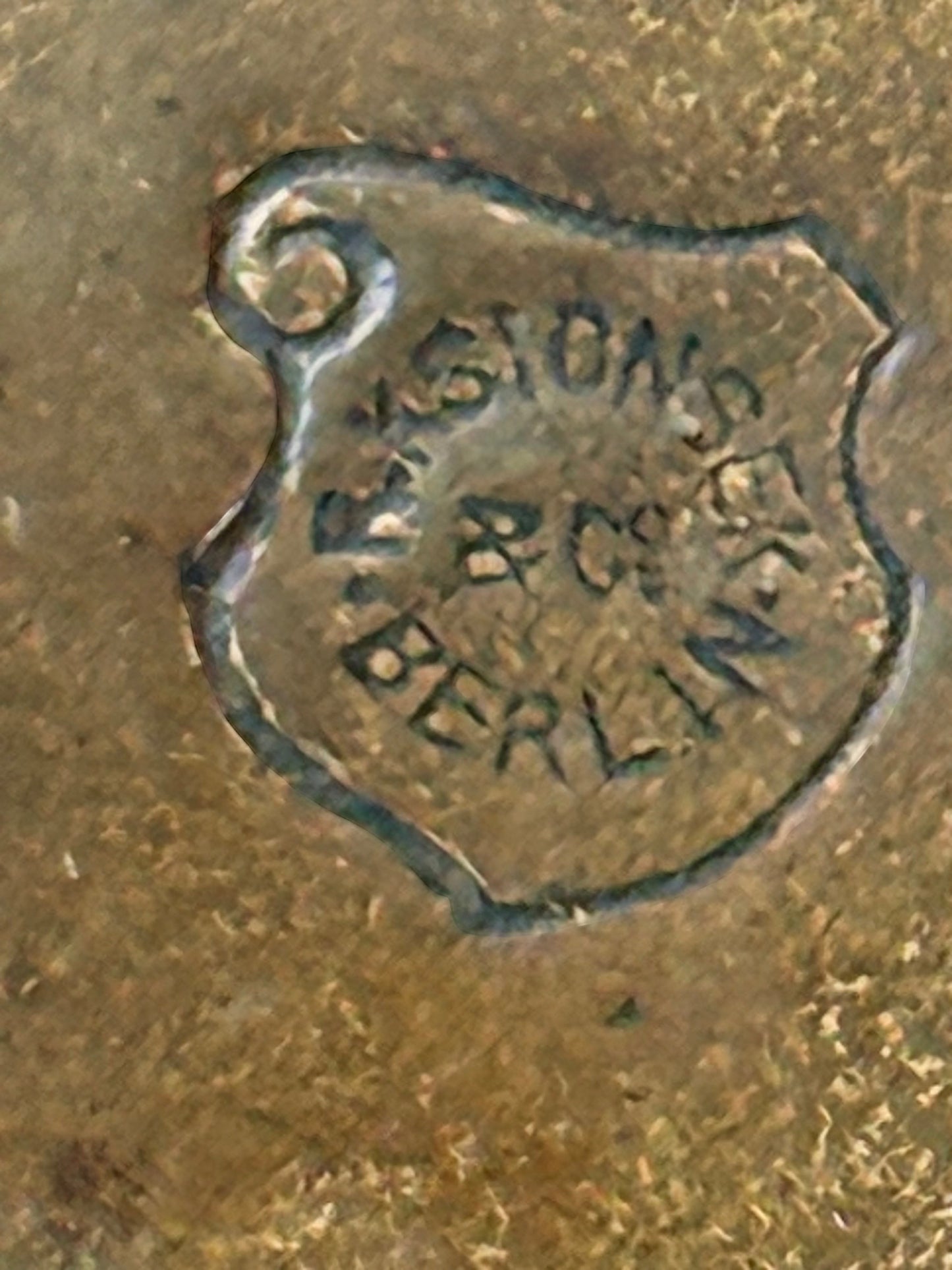
Signed Bauke on the bronze plinth in a confident hand-cut script. Cast by Aktien-Gesellschaft vormals H. Gladenbeck & Sohn, Berlin — the foundry stamp impressed in a shield-shaped cartouche alongside the signature. Mounted on its original cylindrical green serpentine base.
The subject is the laureate — the figure crowned with victory, the moment after the contest is decided. The vocabulary is Olympic in the older sense: classical antiquity reimagined through the lens of imperial Germany, when athletic sculpture stood for civic virtue and national vigor. It is the kind of object that lived in a German collector's library, or on the desk of a man who valued what it represented — discipline, accomplishment, the body in service of an idea.
The combination of signature, foundry mark, original patina, and original stone base is the complete package for a German bronze of this period — and a rare one to surface outside of European auction houses.
On the artist
Robert Bauke was a German sculptor active in the late nineteenth and early twentieth centuries, working in the academic figural tradition that dominated German decorative sculpture from the 1880s through the 1920s. His work was cast primarily by the major Berlin foundries — Gladenbeck chief among them — and circulated through the German bourgeois market for the home, the club, and the institution. His subjects tended toward allegorical and athletic figures rendered in the prevailing classical idiom of the period.
On the foundry
Aktien-Gesellschaft vormals H. Gladenbeck & Sohn — typically signed simply as Gladenbeck & Sohn, Berlin — was one of the most important art bronze foundries of the German Empire. Founded by Hermann Gladenbeck in 1851, the firm grew into a major industrial concern by the 1890s, casting work for nearly every significant German sculptor of the period: Reinhold Begas, Adolf Brütt, Louis Tuaillon, Fritz Schaper, and others. Gladenbeck produced the official Berlin casts for public monuments across the German Empire, including the imperial monuments of Wilhelm I. A Gladenbeck stamp is the German equivalent of a Tiffany hallmark on American silver — a guarantee of period authenticity and foundry-level quality.
Condition
Excellent for an object of this age. The original brown patina is intact, with the characteristic warm undertones of high-quality German bronze of the period. Natural verdigris in the recesses of the base — the green oxidation typical of bronze left to age honestly — is present and undisturbed. The figure is undamaged. Surface detail in the hair, sandals, anatomy, and laurel remains crisp throughout. The green stone base is original to the figure, with the expected light wear of a piece that has been on display for over a century. No repairs, no recasting, no polishing.
Dimensions
Total Height: ~16", of which the granite base is ~4"
Share